
Do you really know what your wallet will sign? A practical guide to downloading and evaluating Rabby Wallet
What happens between clicking “Confirm” in your browser wallet and a smart contract executing on-chain? For DeFi power users in the United States the naïve answer—”the network executes the instruction”—omits two crucial intermediaries: the local client that composes and signs the transaction, and the risk-evaluation layer that decides whether signing is sane. Rabby Wallet positions itself explicitly at those two junctions. This article walks through how Rabby works, why its design choices matter for advanced DeFi users, where it improves safety, and where you still need procedural controls and realistic expectations.
If your primary objective is to reduce blind-signing, manage multi-chain complexity, and keep institutional or hardware-backed key custody in play, Rabby offers a distinct mechanism set. The how-it-works matters more than the marketing: transaction simulation, pre-sign risk scanning, approval revocation, and cross-chain helpers are complementary tools that change the decision frame a user brings to each signature.
Core mechanisms: simulation, scanning, and the non-custodial control plane
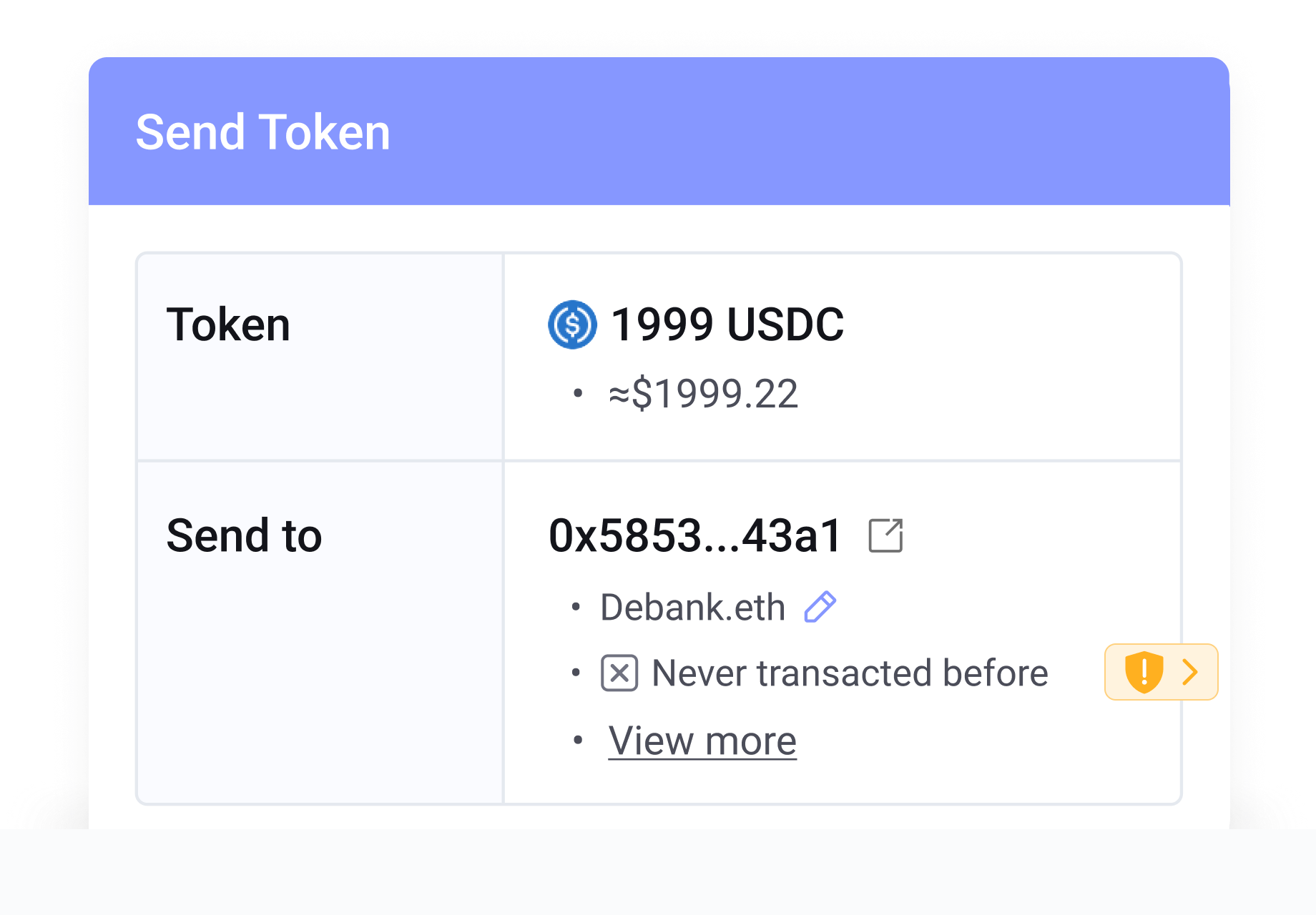
At its technical core Rabby is a non-custodial EVM wallet built to be a “control plane” between you, dApps, and blockchains. The wallet is open-source under an MIT license, which permits independent audits and community review. Its most distinctive mechanism is transaction simulation: before asking you to sign, Rabby constructs a read-only execution of the transaction locally (or via a node) and computes expected token balance deltas and gas consumption. That output is then rendered as a human-readable preview—estimated token changes, fees, and whether the recipient or contract has a suspicious history.
This simulation prevents a common failure mode in wallet UX called blind signing. Blind signing occurs when the UI shows only a terse payment or function name (e.g., “Swap”) while the underlying transaction can include unlimited approvals, token sweeping, or nested contract calls. By exposing the estimated balance changes, Rabby shifts some of the burden of interpretation back to the user and reduces reliance on opaque contract names alone.
Complementing the simulation is a pre-transaction risk scanner. The scanner flags previously exploited contracts, anomalous approval requests (like infinite approvals), and non-existent recipient addresses. That scanner does not make the risk go away; it reframes signing as an evidence-informed decision. For instance, a flagged token may still be safe for a small, time-limited operation, but the explicit alert helps you calibrate the trade-off between speed and safety.
Where Rabby materially changes the risk calculus (and where it doesn’t)
Rabby’s toolkit changes two practical workflows for DeFi power users. First, automatic network switching and multi-chain support (90+ EVM chains) remove a common source of user error: interacting with a dApp on chain A while your wallet is set to chain B. That mismatch has led to failed transactions and lost gas. Second, built-in approval revocation and a visible approvals dashboard change how you manage long-lived allowances: instead of forgetting that Uniswap or a yield farm has an open allowance, you can inspect and revoke from the same client.
But these mechanisms are not a panacea. Simulation is only as accurate as the node state and the assumptions in the gas and oracle data it uses. Complex contracts that rely on off-chain state or on-chain randomness may behave differently when you execute them for real. A simulated “safe” outcome does not guarantee absence of exploit vectors like reentrancy induced by other concurrent transactions, or novel MEV (miner/validator extraction) strategies that only manifest during live inclusion. In short: simulation reduces some classes of error (blind signing, obvious token draining calls) but cannot eliminate protocol-level or system-level vulnerabilities.
Rabby’s 2022 incident—an exploit of a Rabby Swap contract that resulted in roughly $190,000 losses—matters precisely because it shows both strengths and limits. The team froze the affected contract, compensated users, and strengthened audits afterward; that is evidence they treat security seriously. At the same time, the event is a reminder that software and smart contracts carry residual risk even when teams respond rapidly. Open-source code and audits reduce information asymmetry, but they do not remove zero-day bugs or novel attack patterns.
Practical trade-offs for US DeFi power users
Choosing a wallet is choosing a set of compromises among convenience, control, and attack surface. Rabby emphasizes richer local decision data (simulations, scans), hardware-wallet integration (Ledger, Trezor, Keystone, and others), and institutional connectors (Gnosis Safe, Fireblocks). For a US-based trader or treasury manager that needs multi-sig governance or hardware keys, those integrations are valuable: they let you combine Rabby’s UX with hardened custody practices.
Trade-offs you should weigh:
– No fiat on-ramp: Rabby currently lacks native fiat-to-crypto flows. That means for US users who prioritize a single integrated experience for buying crypto, Rabby will be part of a multi-tool chain (custodial exchange or on-ramp service + Rabby for DeFi interactions).
– No native in-wallet staking: If you depend on single-click staking inside a wallet UI, you’ll need external dApps. Rabby’s stance keeps the client lean but shifts some UX friction back to dApp flows.
– Simulation vs. live unpredictability: Simulation reduces human error and catches many dangerous approval patterns, but it cannot substitute for conservative operational controls like test transactions, hardware wallet confirmations for high-value ops, and multi-sig policies for treasury moves.
Downloading Rabby: a short security-minded checklist
When you go to download the browser extension (or desktop/mobile clients), apply the same threat model you use for DeFi: verify sources, minimize exposure, and prefer hardware-backed keys for large sums. A recommended checklist:
1) Download only from verified stores or the official project pages. Confirm package hashes if available. 2) Prefer installing the browser extension on a Chromium-based browser profile dedicated to DeFi activity rather than your general web-browsing profile. 3) Link hardware wallets for signing large transactions—Rabby supports a wide range of devices. 4) Use the approvals dashboard to revoke perpetual allowances regularly. 5) Practice with small transactions first and interpret the simulator outputs—make sure you understand what a “balance delta” looks like for swaps, approvals, and contract interactions.
For a straightforward starting point, the project’s vault of resources and installer links can be found by searching for official project pages—always confirm domain authenticity before you download.
Decision-useful heuristics: when to trust simulation and when to force extra protections
Here are four heuristics that operationalize the benefits of Rabby’s simulation and scanning features:
1) For high-frequency, low-value actions (small swaps, routine approvals under $100), rely on simulation plus hardware signing only for cumulative risk aggregation—still revoke allowances periodically. 2) For one-off interactions with new contracts or tokens, require both a simulation “clean” result and independent on-chain review (look up contract source, verify verified source code). 3) For treasury moves or transfers above your internal threshold, require a hardware wallet + multi-sig flow; do not rely on UI simulation alone. 4) If a transaction is flagged by Rabby’s scanner, pause and use an off-line checklist: verify contract address, check exploit history, and consider a time-locked small test transaction.
These rules turn the simulator from a false safety net into a decision-support tool: it reduces cognitive load but does not excuse operational discipline.
What to watch next
Rabby’s ongoing signals to monitor are straightforward: improvements in simulation fidelity (e.g., better oracle feeds, simulation under mempool conditions), expansion of hardware and institutional integrations, and any changes in the composability between its extension and third-party dApps. Conversely, watch for shifts in attacker behavior—if simulation outputs become a target (for example, attackers that engineer transactions that appear benign under simulation but later diverge), then the value of local simulation would be contested and require further mitigation layers.
Also watch adoption patterns: if more institutional tooling integrates Rabby as a UX layer around multi-sig and custody products, its role could move from a retail safety tool to an institutional control plane—this would change where and how teams expect to rely on its features.
FAQ
How does Rabby prevent blind signing, and is that protection absolute?
Rabby prevents blind signing by simulating the transaction and showing expected token balance changes and fees before you sign. This makes many malicious or accidental drains visible. However, it is not absolute: simulation depends on node state and on-chain conditions at simulation time, and it cannot predict issues caused by concurrent transactions, off-chain oracle manipulations, or some classes of smart-contract logic that conditionally execute based on external inputs.
Can I use Rabby with a hardware wallet and multi-sig for institutional security?
Yes. Rabby supports a wide range of hardware wallets (Ledger, Trezor, Keystone, and others) and integrates with institutional and multi-sig solutions like Gnosis Safe and Fireblocks. Combining these tools is a recommended best practice for treasury-grade operations: Rabby provides the UX and simulation layer while custody and co-sign rules remain enforced by hardware and multi-sig protocols.
Where should I download the Rabby browser client, and which browsers are supported?
Rabby is available as a browser extension for Chromium-based browsers such as Chrome, Brave, and Edge, as well as mobile apps and desktop clients for major OSes. Install from verified sources and confirm package authenticity. For a centralized resource that points to official installers and documentation, see rabby wallet.
Does Rabby eliminate the need to revoke token approvals?
No. Rabby provides a native revocation tool that makes inspection and revocation more convenient, which reduces risk from forgotten approvals. But revocation remains a manual control: you should periodically review allowances and revoke those that are no longer necessary, especially for tokens with ongoing protocol interactions.
Final takeaway: Rabby is a practical evolution in wallet UX for DeFi power users because it turns opaque, binary signing choices into an evidence-backed decision process. Use its simulations, scanners, and revocation tools to lower common operational risks—but retain conservative custody policies (hardware keys, multi-sig, staged testing) for high-value or high-stakes operations. The wallet improves the signal-to-noise ratio of signing decisions; it does not, and cannot, remove fundamental smart contract or protocol risk.